
Leg Exercise and Break Planner for Desk and Standing Workers
Enter your working pattern and hours; get an hour-by-hour leg break plan, a Break Mode timer, a printable desk card and calendar reminders in 2 minutes.

- 1993 – 1999 Medical School
- 2000 – 2006 Specialty training
- 20+ Years of experience
Where she sees patients



Leg exercise at work means using brief, comfortable movements and regular changes of position to reduce long periods of sitting or standing. Desk workers and standing workers may use the planner differently, and persistent symptoms or sudden changes need medical assessment rather than self-management alone. The tool provides general information and does not replace an examination.
- Desk leg exercises are brief, comfortable movements that can interrupt long periods of sitting without replacing overall physical activity.
- Standing workers may benefit from varying posture, moving between tasks and avoiding remaining in one fixed position for prolonged periods.
- The calf muscle pump supports blood return from the legs when calf muscles contract during walking and ankle movement.
- Compression stockings may help selected people with venous symptoms, but appropriate use depends on individual assessment and fitting.
- Sudden one-sided swelling or symptoms such as chest pain or shortness of breath require urgent medical attention.
Your answers stay on your device and are never stored.
Leg exercise during the working day means short, low-impact movements that interrupt long periods of stillness at a desk or workstation. Desk leg exercises usually involve the ankles, calves and knees, and need no equipment. They sit alongside broader vein-health exercises as one part of regular daily movement rather than a separate treatment.
How do you do desk leg exercises?
Desk leg exercises can be carried out while seated or standing beside a workstation, using comfortable movements such as ankle circles and ankle flexion, heel raises, straightening and lowering the knee from a seated position, and brief walking when the setting allows. The aim is simple: to move the joints and muscles of the lower leg at intervals during work that would otherwise be spent in one position.
Form matters more than effort. Movements are best kept within a comfortable range and performed in a controlled way, without forcing a joint that is already painful or stiff. Footwear, available floor space and the nature of the work all affect what is realistic; someone in a seated role with a fixed desk will have different options from someone moving between tasks. A chair that allows the feet to rest flat on the floor makes seated ankle and knee movements easier to perform.
It is worth being clear about what these movements are and are not. They are a way of breaking up stillness during working hours, not a substitute for overall physical activity. The World Health Organization advises that adults aim for 150 to 300 minutes of moderate-intensity physical activity a week, and short workplace movements contribute to that total without replacing it. No particular desk routine can be said to prevent venous disease, and claims of that kind should be treated with caution. People with existing joint problems, recent surgery or diagnosed circulatory conditions may need movements adapted to their situation, which is a matter for individual advice rather than a general plan.
How do standing workers protect their legs?
Standing workers can protect leg comfort mainly by varying posture and movement rather than holding one fixed position for long stretches. Small, frequent changes — shifting weight, altering stance, stepping away from a fixed point, alternating between tasks where the role allows — tend to be more practical than any single corrective measure. The Canadian Centre for Occupational Health and Safety describes measures of this kind, including task variation, suitable work surface heights, footrests or rails that allow one foot to be raised, and supportive footwear chosen for the job rather than for appearance.
Research and occupational guidance suggest that prolonged standing at work may be associated with leg discomfort, heaviness, swelling and venous symptoms in some people, although individual risk also depends on health history, body weight, pregnancy, previous clotting and the specific conditions of the job. These adjustments are reasonable comfort measures that reduce static loading, but they cannot address every factor involved and outcomes differ from person to person.
Age alone does not determine venous risk either. Some people develop younger age varicose veins, often where there is a family history or other contributing factors, while others stand for years without visible vein changes. For that reason, workplace adjustments are best seen as general comfort measures, and persistent symptoms are assessed individually rather than explained by working posture alone.
Compression stockings may help some people with work-related venous symptoms such as aching or end-of-day swelling, but suitability, compression level and correct fitting depend on the individual. They are not a general-purpose item that works the same way for everyone, and they do not replace moving regularly, changing position or seeking assessment for unexplained symptoms. Some people find them difficult to put on, uncomfortable in warm working environments, or impractical with certain uniforms. Poorly fitted garments may cause skin marking or discomfort rather than relief.
A clinician may need to assess circulation and relevant medical conditions before compression is chosen, particularly where there is leg pain, concern about arterial disease, diabetes, skin problems, or a history suggesting circulation difficulties. In those situations, choosing a garment without assessment carries avoidable risk. The sensible route is an examination first, with the type and strength of compression decided on that basis.
How often should you take a break?
Break frequency should be practical enough to interrupt long periods of sitting or standing, and it should fit the person’s duties, symptoms and workplace requirements. No single interval suits every role, and a prompt that cannot be followed in practice tends to be abandoned.
| Working pattern | General approach |
|---|---|
| Mainly seated desk work | Regular brief movement pauses; standing up and walking a short distance where possible |
| Predominantly standing work | Task variation; changing stance and position; sitting when duties permit |
| Mixed work | Movement between duties; avoiding long blocks in either one posture |
A movement break is not the same as a rest break. Someone who has been sitting for a long period usually benefits from getting up and moving, while someone who has been standing in one place may benefit from changing position, walking briefly, or sitting down when the job allows. The planner is an organisational prompt only; it does not replace an employer’s risk assessment, clinical advice, or a person’s own judgement to stop when symptoms appear.
After a long interruption to usual activity — illness, leave, or a change of role — gentle movements can be resumed according to comfort. Trying to compensate with strenuous exercise after a period of inactivity is more likely to cause muscle or joint strain than to help.
What is the calf muscle pump?
The calf muscle pump is the action by which contractions of the calf muscles help move blood in the leg veins back towards the heart, assisted by one-way venous valves that limit backward flow. It is sometimes described in plainer terms as the leg’s muscular pump for venous return.
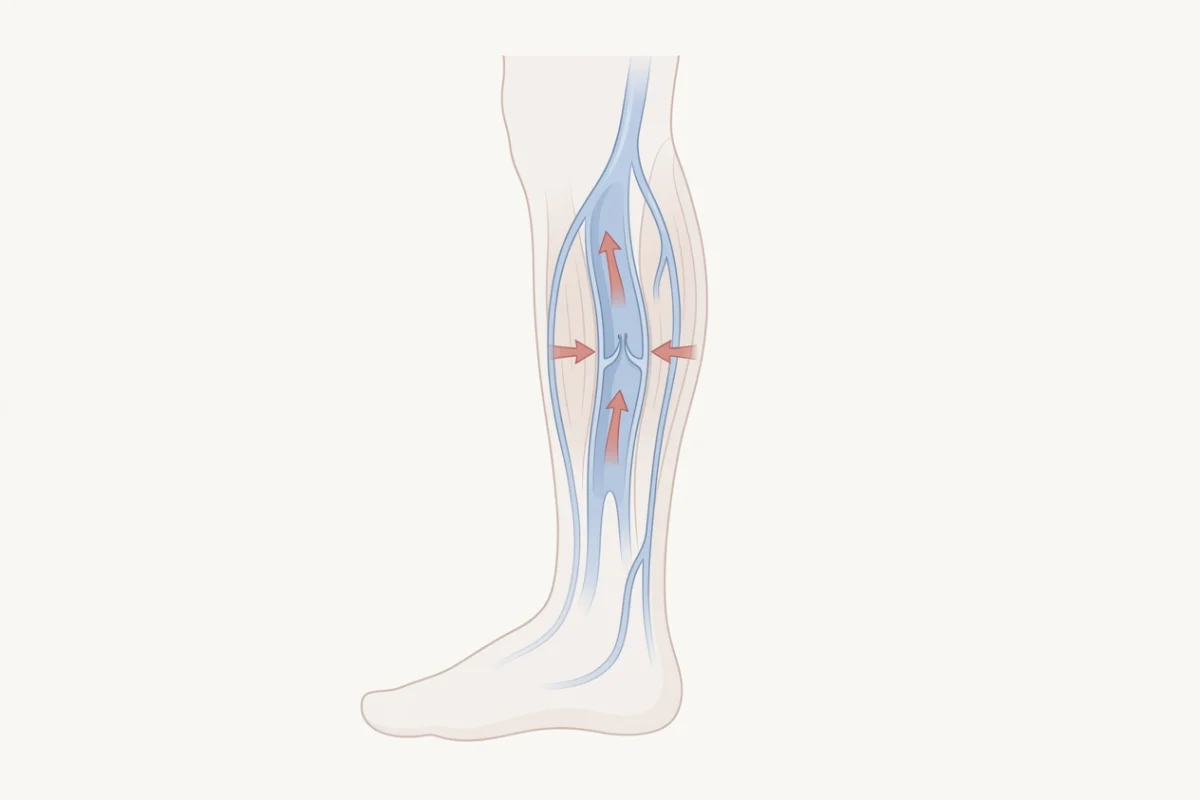
The mechanism is straightforward. Walking and ankle movement repeatedly contract and relax the calf muscles, which compress the deep veins and help push blood upwards against gravity. When a person stays still for a long time — seated at a desk or standing without stepping — this rhythmic assistance is reduced, and blood tends to pool in the lower leg. That is one reason why heaviness or swelling may be noticed at the end of a long working day.
Understanding the calf muscle pump does not mean that movement alone can diagnose, treat or prevent venous disease. Leg exercise may support normal movement and circulation, but persistent swelling, aching, skin changes or newly visible veins deserve individual assessment rather than self-treatment. The European Society for Vascular Surgery guideline on chronic venous disease of the lower limbs sets out the clinical framework within which venous symptoms are evaluated and conservative measures such as movement and compression are considered, always in the context of an examination of the individual leg.
When should exercise stop and a doctor be seen?
A workplace leg exercise should be stopped if it causes sharp or worsening pain, marked dizziness, unusual breathlessness, or any sensation that feels different from ordinary muscle effort. Mild warmth or light fatigue in the calf is common; pain that builds or localises in a joint is not.
Sudden swelling of one leg accompanied by chest pain, shortness of breath, fainting or coughing up blood requires calling 112.
Pushing through pain is rarely useful. Persistent joint pain, particularly in the knee, recurrent leg cramps, or new symptoms that were not present before should be discussed with a clinician before the same routine is continued. An occasional cramp after a long shift is a familiar experience for many people; cramps that recur frequently, wake someone at night, or occur alongside swelling or skin changes belong in a different category and warrant assessment rather than adjustment of the exercise alone.
A doctor should also assess leg symptoms that persist or worsen, visible vein changes accompanied by discomfort, skin changes around the ankle, recurrent swelling, or symptoms that interfere with daily work and sleep. Symptoms that appear only after long shifts and settle fully overnight are less concerning than those that remain, but a change in pattern is reason enough for an appointment.
Assessment generally considers more than the veins alone: circulation, joints, current medicines, weight, previous clotting and other possible contributors are all relevant. An urge to move the legs when at rest, for instance, can reflect restless legs symptoms rather than working posture, and is managed differently.
Equally, progressive skin discolouration, hardening of the skin, bleeding from a vein or repeatedly returning symptoms are reasons not to wait, because untreated varicose veins can develop further skin complications over time in some people.
Where a vein problem is confirmed, discussions about the timing of varicose vein treatment depend on symptoms, examination findings and personal circumstances rather than on a fixed schedule.
This information is general and does not replace an examination; suitability is determined by clinical examination and Doppler ultrasound assessment carried out by Op. Dr. Arzu Ercan, for example at the Istanbul consultation.
Frequently asked questions
Does crossing your legs cause varicose veins?
Crossing the legs is not generally considered a direct cause of varicose veins. Vein problems are more often linked with an inherited tendency, pregnancy, age, body weight, previous clotting, and long periods of limited movement or static standing.
Can I get a note saying I cannot stand for long periods at work?
A work note or workplace adjustment request requires an individual clinical assessment. A clinician can consider symptoms, examination findings and job demands, but a planning tool cannot provide medical certification.
Should the plan be followed every day?
It can be used as a prompt for comfortable regular movement, but it should be adapted to symptoms, working pattern and medical advice, and paused if any movement causes concerning symptoms.
Does Break Mode store my details?
Break Mode does not require medical details in order to show a movement prompt. Any information retained by the browser is explained within the tool interface, and that description should be read alongside the current version of the tool.
Which apps open the calendar file?
A calendar file can usually be opened or imported by common calendar applications such as Apple Calendar, Google Calendar and Microsoft Outlook, though the import steps vary by device and organisation settings.
Can someone with varicose veins follow this plan?
Many people with varicose veins can use gentle workplace movements if they feel comfortable, but exercise does not replace assessment of pain, swelling, skin changes or other persistent symptoms. A clinician can advise when symptoms are significant or changing.
References
Exercise library
The seven movements in the plan. Each card shows the movement, the repetitions and where it can be done; the result screen and Break Mode use the same cards.
-
Ankle pumps
10–15 repetitions
- Heels on the floor, pull your toes up towards you.
- Then point the toes down.
- Repeat 10–15 times at a steady pace.
-
Ankle circles
10 each way
- Lift one foot slightly off the floor.
- Draw wide circles from the ankle: 10 one way, then 10 the other.
- Repeat with the other foot.
-
Seated heel raises
15 repetitions
- Feet flat on the floor, lift the heels while the toes stay down.
- Feel the calves tighten, then lower the heels.
- Repeat 15 times.
-
Standing toe raises
10–15 repetitions
- Hold the desk or counter if you need to.
- Rise slowly onto your toes and pause for a moment.
- Lower the heels with control; repeat 10–15 times.
-
Weight shifting / marching on the spot
30–60 seconds
- Keep the knees soft and shift your weight from one foot to the other.
- If you can, march on the spot or rest one foot on a low step and swap.
- Keep going for 30–60 seconds.
-
Short walk
2–3 minutes
- Get up and walk for 2–3 minutes: the corridor, the office or outside.
- Step heel to toe.
- Fetching water or going to the printer counts.
-
Evening leg elevation
15–20 minutes
- Lie on your back with the legs on a cushion or the arm of the sofa, above heart level.
- Rest for 15–20 minutes.
- Best in the evening for end-of-day heaviness and swelling.
Other tools
- Get a Second Opinion An independent specialist assessment of your current diagnosis and treatment. Get Started
- Online Doctor Consultation Meet via a secure video call before visiting the clinic. Schedule a Call
- Ask on WhatsApp Send your questions directly to our team. Start Chatting
- Free Preliminary Assessment Share your situation and let's map out a personalised plan together. Apply